
What are femicides?
The term femicide describes the killing of women due to their gender. The Federal Centre for Political Education states that this involves gender-specific violence in its most extreme form. It does not just mean the murder of a woman, but one motivated by a hatred of women, patriarchal power structures and the idea that women are controllable or dispensable. Femicides are therefore different from other homicides. They are an expression of misogyny and deep-rooted social inequalities.
In many cases, a femicide happens in the domestic context. The offenders are frequently

(ex-)partners or men from the victim’s immediate social environment. This underlines the fact that violence against women is not just a one-off problem, but primarily a structural one.
Figures for femicides in Austria
A look at Austria shows the urgency of the problem. The group Association of Autonomous Austrian Women’s Shelters continually records femicides and cases of severe violence:
2023: 28 femicides and 41 cases of severe violence against women recorded.
2024: 20 femicides and 33 cases of severe violence recorded.
2025 (figures correct in May): already 7 femicides and 16 cases of severe violence against women recorded.
These figures are shocking. Compared to other countries in Europe, Austria is regularly one of the countries with a particularly high rate of murders of women. According to Zeit Online, although the issue is currently being discussed intensely, the social and political reaction often lags behind reality. The fact that femicides are often trivialised or dismissed as no more than “family dramas” in public debate makes this particularly problematic, and conceals this gender-specific dimension.
Why we need to call this what it clearly is

Naming things clearly is a crucial step in the fight against femicide. When men kill women because they are women, this cannot be played down as a “tragedy” or “jealousy drama”. The term femicide describes the structural causes: patriarchal power, misogyny and denial of equality. In 2024, the German Federal Ministry of the Interior published a situation picture looking at gender-specific violence. This makes clear that femicides are not simply some “random phenomenon”, but actually deeply embedded in social structures. That also means prevention has to start at many levels, from education to the work of the police and justice system, through to providing support for endangered women.
When hatred of women – and that also means sex workers – becomes fatal
Women who are active as sex workers are also vulnerable. Even though there are hardly any systematic data available in Austria, numerous reports have shown that women in prostitution are frequently the target of misogyny, violence and discrimination. They find themselves doubly disadvantaged, both as women and as people in a profession which means they are often socially stigmatised. This stigmatisation creates a favourable environment for offenders to believe violence is justified with no need to fear serious consequences. Femicide involving a prostitute is no different from that of a woman in the domestic environment, however: in both cases, the core of the problem is the hatred of women, denial of rights and worth. We must therefore take a close look at this aspect of the problem, and expand protective measures where necessary.
How we can proceed against femicide
Although there are no simple solutions here, there are many starting-points.
Language and consciousness: The term femicide must be used consistently in the media, in politics and society as a whole. Only like this will it become clear that these are not simply one-off cases, but actually involve a structural problem.
Prevention through education: It needs to be taught at school level that violence against women is never acceptable and that gender equality is a foundation of living together.
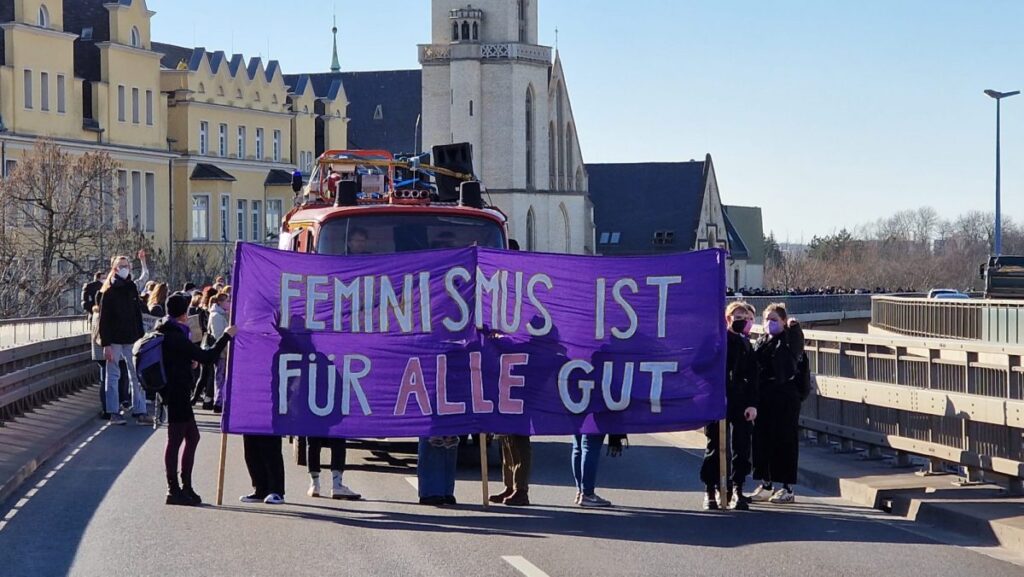
Support for those affected: Women’s shelters, hotlines and specialised advice centres must be financially secure and their range and number extended. The AÖF showed recently just how important low-threshold help is.
Strengthening protective mechanisms: The police and justice systems need clear instructions on how to behave if they are going to be able to take threats seriously. Offenders often show signals of their violence – these warning signals must not be ignored.
Protecting prostitutes: Prostitutes need specific protective concepts which both prevent violence and enable them to report offences without risk. Destigmatisation is a crucial factor here.
Gathering and analysing data: If we are to act effectively in this field, then reliable data are needed. Above all, this should include figures for how many women in prostitution are affected by femicides.
A job for society
Femicides are not simply one-off crimes against women. They are an expression of a system which values a woman’s life less highly than that of a man’s. Every single case is a political and social failure. As long as women are losing their lives in their own home or in the workplace because men consider them their possessions, equality is not being achieved. We all bear responsibility: those in politics, the media, the legal system, educational institutions, every single one of us. It is not enough to express concern whenever a new femicide makes headlines. Continuous work, clear words and decisive action are needed.
Conclusion
Femicides are avoidable. They are not destiny, but the result of social structures which do not value women sufficiently highly. By defining the problem clearly, offering protection to those affected and challenging patriarchal models, we can save lives. Austria’s shocking figures from 2023 to 2025 should be a wake-up call – not just for politics and institutions, but for us all. Because every life lost is one too many.
Translated byTim Lywood
#Femizide #Frauenmorde #geschlechtsspezifischeGewalt #FemizidDefinition #ZuhausegefährlichfürFrauen #GewaltgegenFrauen #FemizideSexarbeiterinnen #PräventionFemizide #FrauenhäuserÖsterreich #PatriarchaleGewalt #AgainstHumanTrafficking #GegenMenschenhandel #EndExploitation #EndTrafficking #HopeForTheFuture #Österreich