
Bananas are one of the world’s favourite fruits. This is no surprise as they are versatile, affordable, and delicious. Whether blended into a smoothie, baked into a cake, or enjoyed as a quick snack, bananas have become an everyday staple.
Yet the reality behind this golden-yellow fruit is far from sweet. Its production is linked to severe environmental pollution caused by pesticides, exploitative working conditions, extremely low wages, and workers who must fight every day for their basic rights. Those who speak out for better conditions often face intimidation, threats, or even violence. This raises an important question: Who really pays the price for cheap bananas?
Life on the Plantations
The European Union is the world’s largest importer of bananas, receiving nearly one-third of all bananas exported worldwide. Austria also has a strong appetite for the fruit, with the average person consuming around 12 kilograms each year. Most of these bananas come from Ecuador, where the conditions under which they are grown and harvested are often deeply troubling.
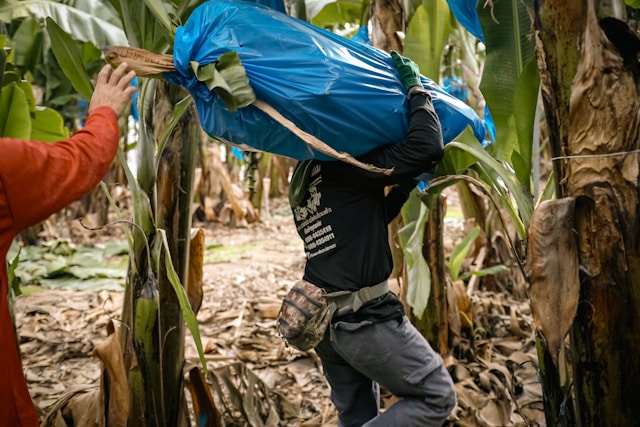
For many plantation workers, the day begins long before sunrise. Shifts frequently last up to 14 hours, far beyond the legal limit. Under intense heat and high humidity, workers perform physically demanding labour with few breaks and constant pressure to meet production targets. Wages are often barely enough to survive on, and in some cases even fall below legal standards. Employment contracts are insecure or nonexistent, and many workers have little or no social protection. Some even lose their jobs shortly before becoming eligible for a pension, allowing companies to avoid costs.
Particularly alarming is the widespread use of highly hazardous pesticides, including chemicals such as Mancozeb. Most workers lack adequate protective equipment: T
- At work everyday clothing is worn, which becomes contaminated with pesticides and is then taken home.
- Protective masks are often used up to a month without replacement.
- Protective aprons often remain in use for a year or longer.
Adding to the danger, pesticides are frequently sprayed from aircraft without prior warning. Workers report being exposed while working in the fields or even during their lunch breaks while eating and although a small number of companies provide advance notice, many workers cannot afford to stop working because they are paid by output.
The health consequences are severe: In addition to acute symptoms such as headaches, skin rashes, and vomiting, chronic exposure can damage internal organs and even harm the DNA.
Some regions have reported unusually high numbers of children born with severe congenital conditions. At the same time, comprehensive scientific studies are often lacking, making it difficult to prove these links and hold companies accountable.
Despite these hardships, many workers have few alternatives. In economically disadvantaged regions, banana plantations are often among the only available employers. This dependency makes it extremely difficult to challenge abusive conditions. Losing a job may mean losing the family’s only source of income.
Women are particularly affected, as they often receive lower wages for the same work, perform additional unpaid labour, and face disproportionately high levels of discrimination and sexual harassment.
Being a Trade Union Activist Is Life-Threatening
Standing up for better working conditions can come at an enormous personal cost in many banana-producing regions: Those who expose abuses or attempt to organise workers frequently become targets of intimidation.
Trade union activists repeatedly report threats, harassment, and deliberate attacks. The situation reached a dramatic point in 2023, when several coordinators of the trade union ASTAC received death threats. Some felt compelled to temporarily leave their country for their own safety with support from the European Union. Others stayed and paid a heavy price. In one case, explosives were detonated outside the home of a trade unionist, and the building was also targeted by gunfire.
Fearing further attacks, many trade unionists now regularly change their place of residence to avoid being tracked down. A genuine sense of safety remains mostly out of reach.
Calls for a Stronger EU Supply Chain Law
Given the difficult working conditions, the pressure on politicians is growing. At the centre of the debate is the proposed EU Corporate Sustainability Due Diligence Directive (CSDDD), which aims to hold companies more accountable for human rights violations throughout their supply chains.
Organisations such as ASTAC and Südwind argue that the legislation must not be weakened. In their view, it is a crucial step towards protecting the fundamental rights of workers. Only clear legal obligations can ensure that companies accept responsibility – not just on paper, but in practice.
Evidence already suggests that such legislation can make a difference. Germany’s Supply Chain Act, for example, has enabled trade unions to request information directly from major supermarket chains, helping to expose abuses within banana supply chains.
However, responsibility does not lie solely with governments and businesses. Consumers also have the power to influence the system through more informed purchasing decisions. According to trade unions, choosing organic products alone is not enough. Many widely used certification schemes fail to adequately protect workers’ rights or prevent labour abuses.
Instead, trade unions point to initiatives such as Comida Justa (“fair food”), where workers themselves play an active role in monitoring compliance with labour standards directly on plantations.
Translated by Julia Matzinger
#HumanRights #StopExploitation #LabourRights #ModernSlavery #HopeForTheFuture #BananaHarvest #ProtectWorkers #PreventHumanTrafficking #AgainstHumanTrafficking #EndExploitation #EndTrafficking #Austria